
Why the Dutch rental market makes corporate housing the only reliable option for assignees
Published on: 28 July 2026
Relocating a top-tier international assignee to the Netherlands has always been an exciting milestone for a growing company. However, in 2026, global mobility managers and HR departments face a historic operational hurdle. The Dutch housing market is no longer just "competitive"— it has reached a structural bottleneck where traditional house-hunting methods actively jeopardize corporate talent onboarding and compliance.
Why is the Dutch rental market so hard to navigate in 2026?
The private long-term rental sector in Dutch is facing an unprecedented supply squeeze. Driven by the nationwide housing deficit and strict rental regulations introduced over the past two years (such as the Wet betaalbare huur), private landlords are selling off their portfolios in record numbers rather than re-letting them.
Data from the Q2 2026 Pararius Rental Monitor highlights a severe national trend: the net outflow of properties leaving the free-sector market heavily outpaces new listings. This massive drop in supply has concentrated demand and pushed remaining free-sector properties into higher price brackets. Nationally, over 42% of all available private rental listings now command a monthly rent above € 2,000, leaving the mid-market segment heavily depleted.
In Amsterdam, the most expensive rental market in the country, prices for an unregulated 2-bedroom apartment (around 70m²) routinely sit at a baseline of €1,800+ per month, completely excluding utilities. This staggering reality has triggered two possible roadblocks for relocating assignees and begs the question:
How much salary does an assignee need to rent in Amsterdam?
The 3x monthly income wall
To mitigate risk, landlords and property managers strictly demand a gross monthly income of at least three times the monthly rent. According to the Pararius Rental Monitor, the average nationwide free-sector rent has climbed to €1,882 per month (a 3.1% increase compared to last year). At this current average, an incoming assignee must prove a documented gross salary of at least €5,648 per month simply to pass an agency’s initial automated digital screening. In premium expat cities like Amsterdam, where rents for a standard 2-bedroom apartment easily surpass €2,200+, that day-one hurdle instantly jumps to a staggering €6,600+ per month.
The "70/30" income trap for couples
If an assignee relocates with a working partner, corporate mobility teams assume their combined wealth makes screening easier. However, often a couple may only count both salaries for 100% if one partner earns at least 70% of the total household income. For an apartment priced at € 1,837, if the assignee earns € 4,500 and their partner earns € 2,200, their balanced 67/33 split causes the automated portal to devalue the secondary income—resulting in an immediate, algorithmic rejection despite them technically making enough money.
AMSTERDAM PRIVATE RENTAL SCREENING (CASE)
Property Profile:
• 70m² | 2 Bedrooms
• Monthly Rent: €1,837 (Base)
Single Income:
• Must hit 42x base rent
• Min. Gross Salary: €77,154/year (€1,837 x 42)
Couple Income:
• Split must be 70/30 or higher
• 65/35 or 60/40 splits trigger immediate automated rejection
How can companies get assignees housed without the income-multiple hurdle?
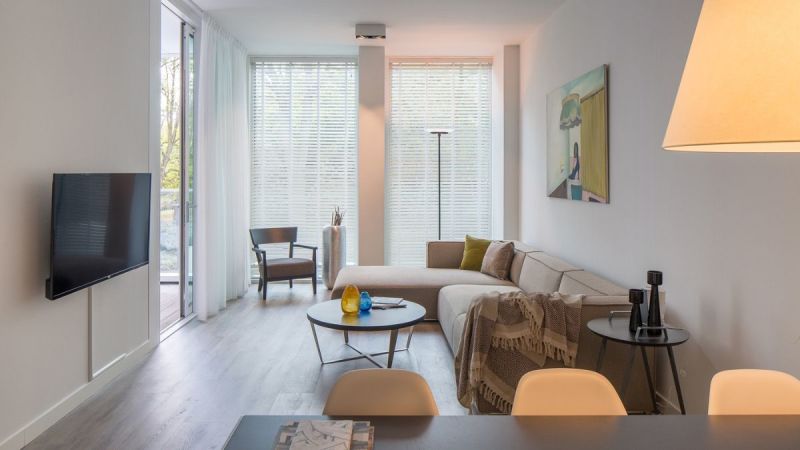
This is where fully compliant corporate housing steps in as the single dependable bridge for corporate relocation. Operating entirely within the legal framework of Dutch residential tenancy law, registered corporate serviced apartments bypass the operational friction of both the private market and the tourism sector.
- BSN registration from day one: Corporate Housing Factory apartments support official municipal registration from the moment your employee lands. This completely unclogs the onboarding pipeline, ensuring your assignee can register with the municipality and receive their BSN within their first two weeks.
- Zero income-multiple friction: Because these accommodations are managed through corporate agreements, your assignees do not need to provide local Dutch tax records, satisfy complex 70/30 income ratios, or compete against dozens of desperate applicants in public open-houses.
- Complete budget predictability: Energy and utility costs in the private sector remain highly volatile. Serviced corporate apartments bundle high-speed secure Wi-Fi, water, gas, electricity, and premium contemporary furnishings into a single, predictable invoice with zero hidden costs.
Frequently asked questions
How long can assignees stay in corporate housing — and what happens after?
First off: what is corporate housing?
Corporate housing or serviced apartments are fully furnished apartments, ready to move into from day one — bed, kitchen, sofa, and everything else already set up. Gas, electricity, water, high-speed Wi-Fi, and weekly cleaning are all included, so there's no setting up separate utility contracts, no waiting on installation appointments, and no surprise bills. For an assignee arriving in a new country, it means they can land, unpack, and start working — without spending their first weeks chasing paperwork just to get the lights and internet turned on. Corporate Housing Factory offers serviced apartments in five major Dutch cities: Amsterdam, Arnhem, Eindhoven, The Hague and Rotterdam. Here's our full guide on corporate housing .
Can my assignee live several years in a serviced apartment?
It is important to note that corporate serviced apartments are designed as a temporary transition tool, with stays legally capped at a maximum of one year. Rather than a permanent housing solution, this provides assignees with critical administrative breathing room. It allows them to bypass the initial chaos of arrival, secure their BSN, build up local Dutch payslips, and comfortably source a long-term private rental from a position of financial stability.
Curious about our serviced apartments? Book a viewing today – no strings attached.
___
Article written by: Claudia Vrancken, Marketing Specialist